
Maddy Nenke
Pilates meets Physio.
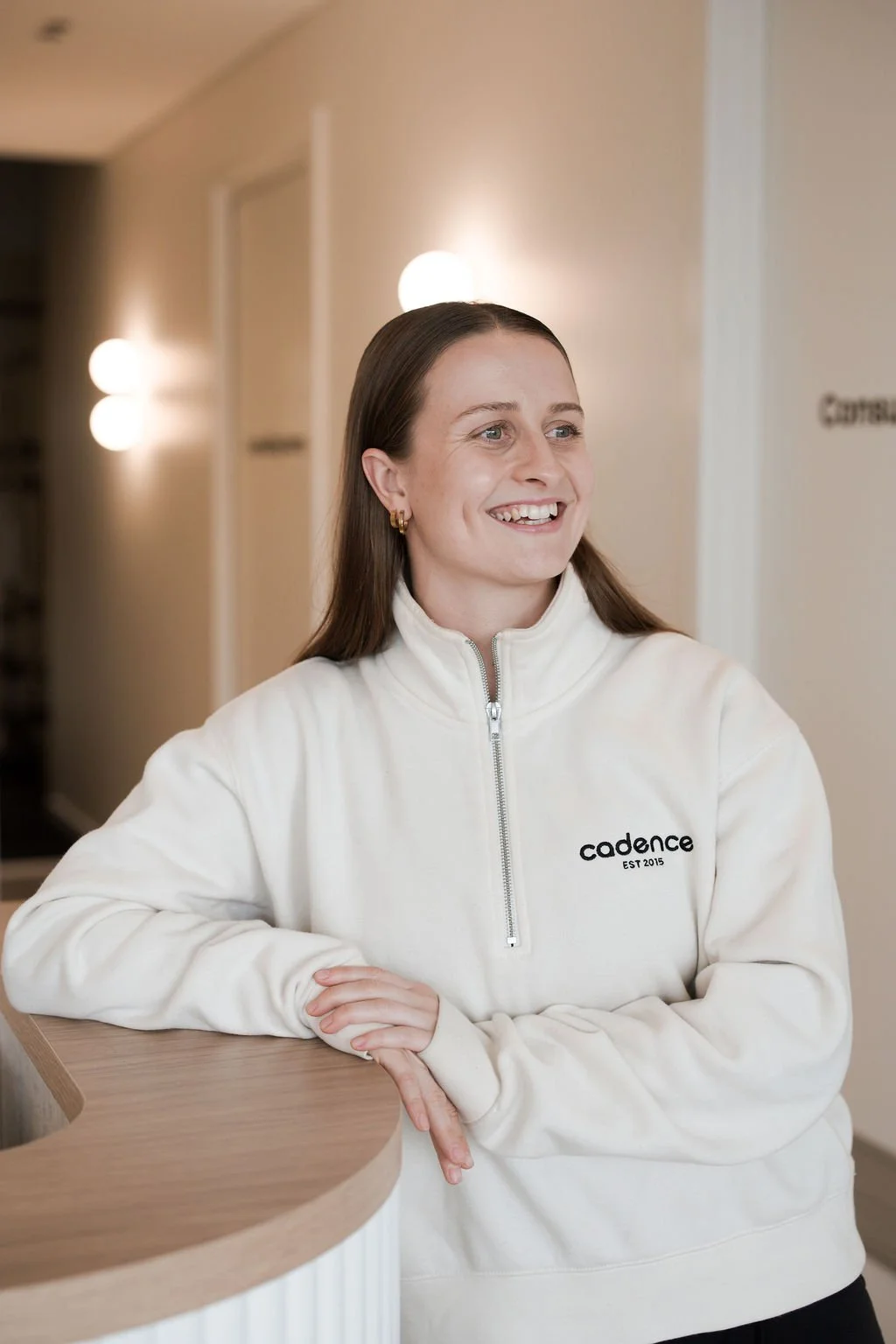
With years of Pilates experience behind her, Maddy brings her love of movement into physiotherapy and rehabilitation.
Get to know Maddy's approach
With years of Pilates experience under my belt, stepping into my physio degree as a new grad still felt like being a fish out of water. All the clinical reasoning, assessment frameworks and terminology were brand new and it took time to feel confident in the clinic.
But with the help of my Pilates background, I was able to rehab clients using movement patterns and control strategies I already trusted and understood deeply. It gave me a framework to build my early clinical skills around rather than starting from scratch.
Pilates has become one of my go-to tools for rehab. It bridges the gap between "gentle exercise" and genuine strength and motor control work and it gives me a huge amount of variety to individualise a program.
Here are my three favourite reformer exercises and three favourite mat exercises and the reasoning behind each pick.
Reformer Favourites
Three movements I keep coming back to.
Mermaid Stretch on the Box
This one's a favourite because it does double duty. It's a genuine thoracic spine mobiliser and it teaches active control through rotation rather than just passive stretching.
Read Maddy's full explanation
Using the resistance of the reformer spring, the arms stay active as the trunk rotates and side-bends, which turns a simple stretch into a controlled strengthening moment through range.
Thoracic rotation is something so many of my clients are missing, particularly people who sit at a desk all day. Restricted thoracic mobility doesn't just cause mid-back stiffness. It also drives compensation up into the neck and shoulders and down into the lumbar spine.
I like progressing the rotation gradually within this exercise because it lets me load a stiff or guarded thoracic spine safely without clients feeling like they're being pushed into a scary end-range stretch.
Glute Bridge
I'll be honest, this is the exercise clients love to hate. It looks deceptively simple and it's often dismissed as "too basic", but it's one of the most useful exercises I prescribe for building hamstring strength and length alongside glute strength, which makes it brilliant for hip, knee and lower back rehab.
Read Maddy's full explanation
On the reformer I can decrease resistance through the springs, work single-leg variations or change foot bar position to bias hamstrings versus glutes depending on what the client needs.
Small tweaks like knee flexion angle in single-leg variations also change the balance between hamstring and glute activation, so I use those variations deliberately depending on the client's goal.
Mid-Back Series (Deep Core Focus)
The reformer's mid-back series is where I feel like I get the most "bang for buck" in a session. It challenges deep core control while also demanding against resistance, which is exactly the combination most desk workers and post-injury clients need.
Read Maddy's full explanation
I like that it isn't just an abdominal exercise dressed up as a back exercise. The instability and resistance of the reformer forces genuine co-contraction of the deep core and paraspinal stabilisers to keep the spine controlled through movement rather than letting momentum do the work.
For rehab clients specifically, I find this series builds confidence with spinal loading in a controlled, graded way, which matters a lot for people who've become guarded or fearful around back movement.
Mat Favourites
Less equipment. Just as much opportunity to build strength and control.
Prone Dumbbell Upper Back Work
Any prone dumbbell work targeting the mid-back is a firm favourite of mine. Living in a world of desk workers with universally rounded shoulders and a forward head posture, this is the single category of exercise I prescribe most often outside the studio.
Read Maddy's full explanation
Working in prone specifically takes gravity out of the "cheating" equation. Clients can't shrug or use momentum the way they can standing, so the mid and lower trapezius, rhomboids and posterior deltoids actually have to do the work.
Programs targeting these exact muscles are consistently recommended for correcting the rounded-shoulder posture that comes from prolonged sitting because they directly strengthen the muscles responsible for scapular retraction and control. That's the weak link behind that hunched desk posture.
I usually pair prone rows, prone Y and T raises and reverse flys since each hits a slightly different part of the upper back and rotator cuff complex.
Side Plank
Side plank almost never gets programmed enough and that's a shame because it's one of the most efficient exercises going. It hits shoulder stability, obliques and glutes in one static hold. It's a three-for-one that's hard to beat for time-poor clients.
Read Maddy's full explanation
I love prescribing this one because of how much it delivers for so little time investment. The shoulder has to stabilise the entire body weight through the supporting arm, making it quietly excellent rotator cuff and scapular stability work while the obliques and glutes fire hard to keep the hips lifted and the body in a straight line.
For clients with hip, knee or lower back issues linked to poor lateral hip control, I find this exercise translates really well into everyday function like walking and single-leg tasks.
It's simple to cue, set up anywhere and easy to progress with leg lifts, arm reaches or an unstable surface once the basic hold feels solid.
Mid-Back on the Mat
I've put mid-back work on the mat as its own category because there are just so many ways to approach it and that variety is exactly why I love it.
Read Maddy's full explanation
Whether it's a controlled back extension, a segmental articulation through the thoracic spine or an extension-based series designed to counter the flexion-heavy "ab curl" style Pilates is sometimes known for, mat-based mid-back work gives me endless options to match the exercise to the client in front of me.
For rehab clients specifically, I find this is where the most meaningful posture change happens. So much of Pilates mat work traditionally emphasises flexion (think classic curl-based ab series), but for people who spend their day rounded forward over a screen, deliberately programming extension-focused mid-back-targeted work is what actually counters that pattern day to day.
It's low-load, achievable early in a rehab program and gives clients an obvious "I can feel that working" response, which helps with buy-in and adherence.
As always, exercise selection should be individualised to the client's presentation, stage of rehab and goals. These are simply the exercises I reach for most often and why I rate them so highly.
Ready to find your kind of movement?
Whether you're building strength, returning from injury or simply looking to move with more confidence, our team is here to help you find what works for you.